Transcript:
John Gilroy: The views expressed in this podcast or on www.constellationspodcast.com do not officially represent the views of the US military or the United States government. The appearance of US Department of Defense, DOD, visual information does not imply or constitute DOD endorsement.
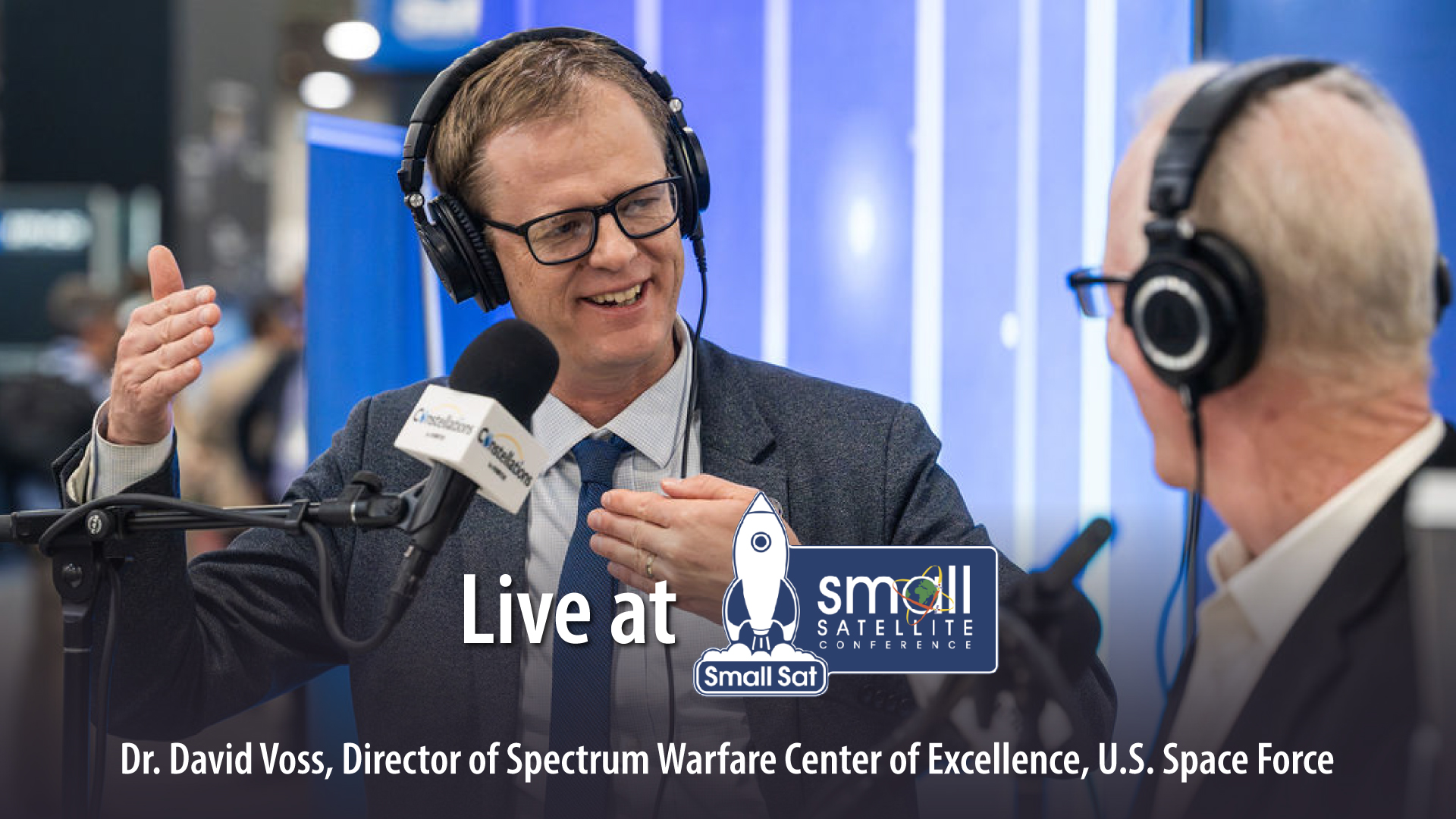
Welcome to Constellations, the podcast from Kratos. My name is John Gilroy, and I’ll be your moderator. Today, we are here at the SmallSat Show in lovely downtown Salt Lake City, Utah. Our guest is Dr. David Voss, director of the Spectrum Warfare Center of Excellence at the Space Warfighting Analysis Center, or SWAC is what you say it, right?
Dr. David Voss: SWAC, yeah.
John Gilroy: SWAC. Good, good. He and his team’s analysis and recommendations have informed Space Force’s budget decisions that will provide critical warfighting capabilities for guardians and the joint force. Dr. Voss is a recognized leader in space systems architecture and standards whose work has helped bring together government, industry, and international partners to solve some of the most complex challenges facing the space community. Today, we’ll discuss why architectures matter, what resilience really looks like in practice, and what is possible as the space community moves toward a more connected and interoperable future.
Dr. Voss, ready to go?
Dr. David Voss: Let’s do it.
John Gilroy: Yeah. Good, good, good. To start off, tell us about your organization. Why was it established and what mission does it serve within this big broad space community here?
Dr. David Voss: Thank you. Thanks for the opportunity to be here as well.
So, our organization is an analytic organization. We have a variety of tools to help us understand how the Space Force should invest in capabilities to support the joint force across the broad range of mission areas. Historically, I like to think of there are three eras in space. The first era of space was really the discovery of space. So, that was where we discovered the Van Allen radiation belts, we learned how to put things in orbit and make it work. The second era was about acquiring reliable, capable systems that were deeply integrated into our infrastructure on the civilian side and into our military, and those are typically delivered by, I think, homogeneous services. And so, a lot of the analytic tools and a lot of the analytics that have been done historically are really about what’s the most optimal single architecture to provide capability for the joint force.
Where we live now is, I think, in the third year of space where we really have some of the things I touched on in terms of the hybrid architecture this morning. We really have a broad range of opportunities to deliver services or multiple orbits. We have the complexity of how do you bring commercial and allies into the architecture, when do you use military services for particularly warfighter effects versus where can you leverage commercial or allied services, how do we implement that, and so we had to really create a set of tools and frameworks to be able to leverage those capabilities to be able to recommend investments within the department and how to communicate those. Our organization was really established to do that type of cross-capability analysis in a particular mission area and then, as we’re really growing, to be able to provide that analysis across missionaries as well within a variety of capabilities that go together.
John Gilroy: David, here we are at SmallSat with 5,500 of your closest friends.
Dr. David Voss: It’s a family reunion.
John Gilroy: And there’s all kinds of little tables set up here and a lot of conversations taking place. I’m sure they’re talking about space architecture. So, when people sitting around here talk about future space mission architectures, what do you think they’re getting right and what are they not getting right at all? What are they overlooking?
Dr. David Voss: I mean, it is very exciting to see the maturity of the capabilities that we can do with smallsats these days. Having been in the community a long time, we went from tech demos to then individual sensors performing kind of missions that have fairly large gaps between them to now individual, I would say, homogeneous constellations providing really impressive… Whether it’s kind of ISR, sensor related, our gap time is going down, we’re getting better resolution, we’re adding other phenomenologies that you’re seeing here beyond just EO. You have SAR, you have RF services, communications. We are seeing direct-to-device take off. So, there’s a lot of really excellent examples of how the smallsat community is delivering meaningful capability. I think we have a long way to go to still understand manufacturing readiness levels and how do we really move out of, “We launch a lot of capability, a lot of tech demos. How do we migrate that into the ability to now provide operational capability?” conversation many of us have talked about for a long time. I think we, as a community, need to continue to mature, I think, within the manufacturing readiness level area.
I think also there’s a lot of opportunity for cross capability. We talked about that today, what happens if smallsats had ubiquitous comm and better PNT? What could we do that we can’t do right now? And so, I think many of the analytics on my team that we’ve been analyzing is this drive towards you can do amazing things in the small sat platform, but we still suffer significantly from large gap times in our connections with the satellite. So, that does drive a level of autonomy, and I think people are getting after that. But when we can provide constant connectivity where we don’t have to build the whole C2 architecture to enable this demo, how does that enable even better and more capable systems that we can provide the community, whether it’s the civil side or the military side?
John Gilroy: Civilians and military folks all talk about resilience. That’s a hot topic here. So, from your perspective, what does a truly resilient space architecture look like?
Dr. David Voss: There’s some doctrinal definitions. There’s been some great papers written on this over the years. I’m not a big fan of the terminology per se to be fully doctrinally accurate. I think a lot of it comes down to as your system is being interrupted, it could be interrupted due to natural causes, it could be interrupted due to adversary reasons, are you still able to deliver a capability that the user needs as you’re being affected by either natural or non-natural causes? When you have a homogeneous situation, if that’s your only way to deliver that capability, whether it’s a sensor or a comm signal, even if it’s a fairly robust system to interference, eventually if that goes down, then that’s all you have. You go from working to not working for the most part. And so, a lot of the resiliency that we look for is, how do we provide graceful degradation to really a broad spectrum of orthogonal threats as we think of them? There are reversible, irreversible kinetic and nuclear threats.
And so, as you look at that broad spectrum of effects that can happen, how do we ensure that, as more and more of those effects happen or are stacked on top of each other, we have the ability to provide that kind of… even if it’s an MVP capability to the user, how do we provide that? A lot of the analytics that we do will be looking at large parametric analysis across individual threat vectors or across orthogonal threat vectors. And then the capabilities you recommend is kind of the optimization of cost, once again, performance, how do we have the appropriate kind of degradation across the largest number of threat vectors? When you live in that kind of cube of possibility space, that’s really where resilience lives. Robustness and resilience lives for us is, how do we affordably provide the best kind of value to the joint force as you live in a contested domain these days?
John Gilroy: Well, I got a question about this cube thing here. Maybe go outside the cube a little. How can we improve resilience through non-kinetic means, such as software, networking, interoperability, automation, maybe operational flexibility? It’s a big package here, isn’t it?
Dr. David Voss: There’s a lot there. Once again, building ground-to-space connections is hard, building space-to-space connections is hard. One of the things that we want to make sure that we’re designing in is the capacity. If we can do load shedding across the variety of paths, whether it’s ground to space or space to space, we lose nodes. Even in the best of days, nodes can be lost, equipment can fail. And so, how do we really not only design for the understanding that that’s the normal kind of world, but especially during an intentional kind of conflict as well? Really being able to design for it, but also test for it and operate that way as well is critical. So, being able to manufacture events that we know will happen, but we don’t ever practice or train for them as well.
One simple example is GPS has been so integral to so many of our civil and military systems. Could you imagine if we turn that off for 10 or 20 minutes just to say, “You know what? We need to be thinking of hybrid PNT architectures. There are many commercial architectures that leverage other sovereign systems. There’s exciting LEO-PNT capability coming online.” So, what happened if every sovereign system took 10 minutes and turned off for a little while to make sure that we have that resiliency across the PNT architecture? That’s not something we do as a community, not just the PNT community. So, we really should be practicing for disruption in addition to designing for it.
John Gilroy: So, David, this is the Constellations podcast, so I got to ask you a constellation question. It’s only appropriate, isn’t it? As proliferated constellations continue to grow, how should governments and commercial operators think differently about mission architecture rather than just throwing up more satellites?
Dr. David Voss: Great question. The constellations you see today might not be the constellations you see tomorrow. And so, when you look at the service you’re trying to get… and this is very hard for all of us because, especially at small sat here, we live on the technology side of it. We know the value of maybe our particular phenomenology. When you’re a government side, you want the service or the capability to be extended over time. If we can move out of a little bit on the government side, prescribing the particular solution to the thing we are trying to acquire or provide to the service, if we can move more towards being to accurately identify this is the capability we want, you can oftentimes get after those objectives with a variety of phenomenologies or approaches depending upon what the mission areas you’re going after. That’s not how a lot of our current acquisition POM process works.
A lot of it is anchored on particular program elements that have particular capabilities assigned to those, which are providing a particularly traced requirement. Once again, I call it the economic theory of space. If we can really move into the economics of how do we promote this capability across constellations, the constellations can come and go as the business models make sense or don’t make sense, but we’re not locked in. This hopefully will promote vendor diversity, it promotes innovation, but that oftentimes requires a retooling of a lot of how we think about acquiring space capabilities really from that second year of space.
John Gilroy: David, I listened to your enterprise presentation this morning. I don’t think you mentioned the ground segment, unless I’m mistaken. So, how important is the ground segment in future mission architectures, and do you think it’s receiving the attention it deserves?
Dr. David Voss: When you talk to space people, the most important thing is the satellite. There’s a user segment, a space segment, and a ground segment. I think a lot of us have thought about the ground segment, once again, married to the particular space capability. Much of the attributes we talked about today on the enterprise is also true for the ground segment. How do we think about the mobility side on the ground the same way that I was discussing it today at the enterprise talk? You’ll see a common theme in the backhaul, basically the user through the space architecture, through the SDN, the grounding of that data, and then the distribution to the various processing locations. We still see a lot of the same challenges that are on the legacy space architecture on the legacy ground architecture. We typically tie functions to individual metal or individual locations, and that creates a fragility similar to what we saw in the geo layer of the past.
And so, we really need to move into the same kind of thinking about… So, I have an entire division focused on ground data networks and how do we apply the same idea of information mobility across the ground segment as you enter the gaps of the ground entry points. And then as that moves laterally then through the global fiber architectures and then getting to the data processing stacks, if you think of the OSI stack, it’s the same idea. There’s a processing layer, the applications layers. And then where do we have the guardians that are able to then be flexible to live on top of that distributed processing stack? And so, there is an entire other version of this brief at some point I would love to give for the ground side.
John Gilroy: David, pick up your phone, look at the news, and believe it or not, the topic of open standards is coming up in headlines in the news. I mean, who would’ve thought that five years ago? So, what role do open standards play in enabling coalition operations and helping governments adopt new technologies without becoming locked into this proprietary stock?
Dr. David Voss: Yeah, standards is a great conversation. I actually wrote my PhD in modular open standards for satellites a long time ago. Don’t go read it, because it’s way out of date, for those of you who might be interested. The amount of emotions on standards typically range kind of into two categories. You have the one standard to rule them all, and in the darkness, bind them, which basically means you create another standard. I cannot tell you how many hours of my life I have lived arguing standards with people who they want one standard. I think the challenge with standards is, and I liked Joe’s brief at the very end, you want to share the risk and you want to share the value, he was talking about in terms of ecosystems.
And so, when you look at standards, you want people who are involved in benefiting from the standard, but also the risk of, when you become critically dependent on a standard and other people, you expose yourself in a way that’s different than a perfectly vertically integrated architecture. And so, you really want to bring the right people together to talk the standard. It’s typically not one, so you need to make sure the standard is anchored in real… it’s tied to the phenomenology, it’s tied to the architectural elements you’re trying to standardize. You don’t typically want one to, once again, rule them all. And so, knowing the right standard for the right portions of the information mobility process is really important.
It is very challenging, I would say, for the government to be the owner and author of standards. We obviously care about them deeply, we want to be part of that process, but I think when you look at very complicated technical standards, that’s not necessarily the sweet spot for a lot of government employees. And so, we really, I think, need to encourage this community. How do we look at the OV1 I showed today and constellations? How do we create an ecosystem where we have this community where there are highways, there are boulevards, there are side, there are rural roads. How does that kind of architecture come together where we appropriately match both the physical layer, the networking layer, where you’re going local area network versus you’re going wide area network? That’s not oftentimes the same standard per se, and so it needs to be technically driven, and oftentimes you don’t want it to be budgetarily driven as a lot of our investments are.
Once again, that’s my challenge to this community is the sum of the parts, the value coming out of an architecture like that is much greater than the individual parts that we’re talking about here. It’s critical. You can’t succeed in the architecture we’re trying to build without standards. But it’s the right standard for the right interfaces, scoped by really the technology you’re trying to integrate together or kind of cross is really critical.
John Gilroy: So, David, this is a podcast, and people are maybe walking their dog and listening to this podcast. We are recording this from the floor of a smallsat. Look around, and behind you, I see a sign that says, “Virtualized ground.” So, many organizations are pursuing software-defined and cloud-enabled ground systems. So, how do these trends change the way future missions are designed and operated?
Dr. David Voss: I talked about it this morning. Speed is critical. If you have to deploy physical units to every user, to every knock, sock, mock that’s out there, it turns into a time constant. As we look at the progression of software-defined networks in the larger telecom industry, I think the parallels are very strong in particularly the information architecture we’re talking about. When you see the ability to rapidly learn, I hate the term fail fast. The goal is not to fail fast. The goal is to learn fast, which includes failing some of the time. We need to learn fast. We need to feed the learning back into operational use as fast as possible. And so, when you have software-defined elements to the architecture, whether it’s the UE, the user equipment side of the house, whether it’s the network architectures between what we refer to as underlays, so the cloud or the constellation is an underlay in my mind as an architect, there are multiple underlays we stick together at exchange points. That series of exchange points and underlays is how you then facilitate the overlays, the networks you want to write on top of that.
If that’s all physically anchored, so you can’t upgrade it until you have to deploy new hardware, you’re limited by the definition… Even in smallsat world where we’re launching every maybe three to five years, that’s still way better than a 15-year tech baseline. We’re still moving up faster, but we have to go even faster than that. And so, how do we really think about the ability of holding those lessons and… Those lessons we’re learning back in as fast as possible is really the heart, I think, of the software-defined paradigm.
John Gilroy: Well, David, this is the 40th year of the SmallSat Conference. There’s a mandate this year, I don’t know if you got it or not, but you’re not allowed to have a conversation without saying the word artificial intelligence.
Dr. David Voss: Of course.
John Gilroy: I have to include it here too. Artificial intelligence is becoming part of nearly every discussion about space operations. Where do you see AI providing the greatest value in future mission architectures, and where should operators remain cautious?
Dr. David Voss: I think that the cautious part is probably the easiest part where most of us would resonate with. I think we do things in space… These are high-dollar nodes. Even smallsats are not cheap to get up there, especially as you move to higher-cost nodes or vehicles. I think as we think about proximity operations or humans in space or any of those kind of things where you have really critical functions going on, whether it’s the dollar or the satellite, you really want to make sure that the leveraging of some type of intelligence is anchored in elements where you can pop out and make sure before it makes a decision and does something that things are safe. There’s a danger too to rely on some of that capability for abdicating critical thinking. We need to make sure we’re still leading in systems doing what they were designed to do.
With that being said, when you look at the hybrid architecture, you are now hitting… What I like to think of is you’re leaving what is complicated, complicated is engineering and physics dominate the behavior of those systems, and you’re moving into the world of the complex where you get emergent behavior coming out when you start aggregating many, many complicated systems together. It’s almost impossible for the human mind to wrap your head around these large heterogeneous architectures. Some of the things that are interesting is can AI help us stay abreast of the amount of complex data paths our data is taking or help us route data on paths that have better performance because something else is showing network degradation.
There are opportunities there for us to be able to bend over the complexity curve where we see potentially AI being really valuable, where it’s not just purely a, “Test the quality of service of this link. Now, this one. Then this one,” but really actually learn over time. And then that’s the first primary path you go down as one example of many.
John Gilroy: So, David, this morning, you gave a presentation. It was on the general category of future directions. So, I think it’s fair game to ask you a future question. So, looking ahead 5 to 10 years, what architectural changes do you believe will have the greatest impact on national security and commercial space operations?
Dr. David Voss: Yeah, I’ll keep it more within my own force, designing domain. We did not design PNT for the space service volume. We designed it for the Earth. Even as you look at how GPS is, as the three Fs get up there, we are doing a better and better job of getting more power on the Earth as the primary mission of that capability. The consequence is we are now having less power supporting space. And so, any smallsat, any large sat will use a MGNSS architecture to be able to find where it’s at, you can use other mechanisms like ranging, but it’s one of the fastest ways and most accurate ways to do it. What if we provided a more dedicated comm signal or worked with our MGNSS partners and GPS to be able to provide a more dedicated power source to the space service volume where we’re putting energy out there on purpose?
So, think of smallsats where you have ubiquitous comm and ubiquitous PNT. For those of us who have flown satellites, we lose GPS all the time. It’s really hard to get their very weak signals, or we have intermittent comms all the time. When I think about even the analogy that, once again, Joe, you used for the cell phone, when you had that ubiquitous comm and you had cheap sensors on your cell phone combined together with a common filter and PNT over comm to the cell tower, as well as the MGNSS where your cell phone has multiple sovereign systems, when you’ve combined that together, it’s created entire ecosystems out of the cell phone model.
When we think about space, when we think of the users of this conference, imagine if you had ubiquitous comm, and PNT, and LEO, MEO, and GEO are on our way to the moon now as we see the exciting things NASA is doing. What would it do differently in your sensor design? Would you be able to continuously be refreshing the AI models you’re running on your processor? Would you be able to then have lower latencies to get that data to your customer? To me, that’s what I’m super excited about as we’re building a lot of this space data network and as we hope to partner with a larger community. I truly believe it would be as transformative as it was in the ground for our space missions. Most of our missions suffer from lack of temporal resolution, whether it’s space to any number of terrestrial missions. And so, when you have that kind of ubiquitous common and significantly better PNT, what could that enable? That gets really exciting in my mind of where we could go with that.
John Gilroy: So, David, if you could encourage government, industry, and academia to rally around just one priority to improve the future of space mission architectures, so what would it be, and why?
Dr. David Voss: It’s a very, very biased question or answer to that question I want to give you. I mean, once again, we oftentimes forget that network is the enabler to so many capabilities. And so, oftentimes, we love to focus on the mission side of it, and rightfully so. That’s why we’re doing it. But we oftentimes forget the services, the underlay, the infrastructure that facilitates all of those missions. Although it is not as exciting, potentially talking PNT and timing, it’s hard to trace that all the way to a value to a particular kill chain or a value to particular science mission. Having confident networks, we like to say designing a complete network between position data and time, having a complete network completely changes how you think oftentimes of both the science we could do and the missions we can do for the joint force. And so, that is one area that we have got to work together on.
We can’t afford to have every acquisition org or every part of the government build their own version of this. We have done the analysis to show it is many, many, many billions of dollars more than it is if we were to work together on it. That’s really at the heart of, I think, a lot of what we’re trying to do with ubiquitous common PNT is it was designed from the ground up to be partnered with the civil community and with our allies and commercial so that we could then enable a lot of that ubiquitous common PNT.
John Gilroy: Dr. Voss, I think you’ve given our listeners a deeper understanding of the whole concept of space architecture resilience.
I’d like to thank our guest, Dr. David Voss, director of the Spectrum Warfare Center of Excellence at the Space Warfighting Analysis Center.
Dr. David Voss: Thank you.